

Hey there! Let’s chat about something quite fascinating in the world of Rust — strings! In most programming languages, strings are primitive types and are relatively straightforward. However, in Rust, strings are a bit different. Understanding strings in Rust is a gateway to appreciating the language’s unique approach to memory safety and efficiency. Rust brings its unique flavour to handling strings, ensuring that they are both powerful and safe to use. Whether you’re new to Rust or just curious about its strings, you’re in for a treat.
What Are Strings?
Alright, let’s dive in. Before we can appreciate how Rust handles strings, we need to understand what strings are and what encoding is. At its core, a string is just a collection of bytes. Each character you type is represented by one or more bytes. For example, the letter ‘A’ is represented by the byte 65 in ASCII.
What is ASCII?
ASCII is an early encoding standard that uses 7 bits to represent 128 characters. Each bit is essentially a 1 or 0, giving us 2⁷ possibilities — 128 characters at maximum capacity. This includes basic English letters, digits, punctuation marks, and control characters. However, ASCII is limited to representing basic English characters.
Why Move to UTF-8?
As the need for a more comprehensive character set grew, we needed an encoding system that could handle characters from different languages and even emojis. Enter UTF-8.
What is UTF-8?
Now, hold on! This section might seem a bit technical, but understanding it is crucial to appreciating how Rust handles strings.
UTF-8 is an encoding standard that can represent any character in the Unicode standard. Unlike ASCII’s fixed 7-bit per character approach, UTF-8 is variable-length. Here’s how it works:
- 1 byte (8 bits): For standard ASCII characters (0–127), making it backward compatible with ASCII.
- 2 bytes (16 bits): For additional characters, such as Latin and Greek letters.
- 3 bytes (24 bits): For even more characters, including many Asian characters.
- 4 bytes (32 bits): For less common characters, including emojis and certain symbols.
This variability means UTF-8 can represent up to 2³² = 4,294,967,296 ( 4 Billion ) characters! The beauty of UTF-8 lies in its efficiency and compatibility. For most English text, it uses just 1 byte per character, just like ASCII. But when you need more complex characters, it can expand to 2, 3, or 4 bytes as needed. This adaptability saves memory and ensures broad compatibility.
Rust strings are UTF-8 encoded, which means they can handle text from any language while being memory-efficient and compatible with existing ASCII text. This powerful encoding system ensures Rust can handle modern text requirements efficiently.
The Two Types of Strings in Rust
Now, here comes the exciting part. Rust offers two main types of strings:
Sliced String: &str
First up is the sliced string, often seen as &str. Think of &str as a view into a string. It doesn’t own the data it points to; it just references it. This makes it lightweight and perfect for scenarios where you don’t need to modify the string. It’s like looking through a window at a beautiful view—you can admire it, but you can’t change it.
What Is a Reference?
In Rust, the & symbol denotes a reference. A reference allows you to borrow a value without taking ownership of it. This is useful for accessing data without copying it, which saves memory and improves performance.
fn main() {
    let greeting = "Hello, world!";
    let slice: &str = &greeting;
    println!("{}", slice);
}
In the example above, greeting is a string slice (&str). The slice variable borrows greeting without taking ownership, meaning greeting still owns the data, and slice just references it.
Ownership and Borrowing
Ownership is a central concept in Rust that ensures memory safety. When a variable owns a piece of data, it’s responsible for cleaning it up when it’s no longer needed. Borrowing allows a function or variable to temporarily use data without taking ownership.
fn main() {
    let s1 = String::from("hello");
    let s2 = &s1; // s2 borrows s1
    println!("{}", s2);
    // s1 can still be used because s2 only borrowed it
    println!("{}", s1);
}
Memory Efficiency and Allocation
A &str is typically stored on the stack. The stack is a fast, limited-size memory region where data is stored in a last-in, first-out manner. Since &str just holds a reference to data and doesn’t own it, it’s efficient in terms of memory usage and performance.
Pros and Cons
- Pros: Lightweight, fast, no extra memory allocation.
- Cons: Can’t modify the string, lifetime issues can be tricky. Because
&stris a reference, you need to be mindful of Rust’s borrowing rules to avoid dangling references.
Owned String: String
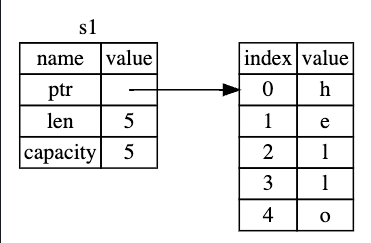
Next, we have the String type. Unlike &str, String owns its data. It’s stored on the heap, allowing it to be modified, resized, and generally used as a dynamic collection of text. If &str is a window, String is the house—you can renovate it, add new rooms, or even tear down walls if you like.
Ownership and the Heap
When you create a String, it allocates memory on the heap. The heap is a larger, more flexible memory region compared to the stack. It allows for dynamic memory allocation, meaning you can request memory as needed during runtime.
fn main() {
    let mut s = String::from("hello");
    s.push_str(", world!"); // appends a string slice to the `String`
    println!("{}", s);
}
In the example above, s is a String that owns its data. You can modify s because it owns the memory on the heap where the data is stored.
Mutability and Flexibility
A String is mutable, meaning you can change its contents. This makes String ideal for scenarios where you need to build or modify text dynamically.
fn main() {
    let mut s = String::new();
    s.push_str("Hello");
    s.push(' ');
    s.push_str("world!");
    println!("{}", s);
}
Memory Management
Since String is stored on the heap, it’s slightly slower to allocate and deallocate compared to stack-based data. However, this trade-off is worth it for the flexibility and dynamic nature of heap-allocated memory.
Pros and Cons
- Pros: Flexible, can be modified, owns its data. This ownership means you don’t have to worry about lifetimes in the same way you do with
&str. - Cons: Slightly more overhead due to heap allocation. The extra memory and performance cost might be a consideration in performance-critical applications.
Converting Between &str and String
Switching between these two is a breeze. You can convert a &str to a String using the to_string() method or String::from() function. Conversely, you can get a &str from a String by borrowing it with the & operator.
fn main() {
    let s: &str = "hello";
    let string = s.to_string(); // &str to String

    let s: String = String::from("world");
    let slice = &s; // String to &str
}
This conversion is powerful because it allows you to use the right type of string for the right situation. You can start with a &str for efficiency, convert it to a String when you need to modify it, and then borrow it as a &str again when you’re done.
The Power of Rust Strings
Rust’s approach to strings is powerful. It ensures safety and efficiency, providing the right tool for the job whether you need a lightweight reference or a full-fledged dynamic string. By understanding these types and how to use them, you can write more efficient and safe Rust code.
So, the next time you’re working with text in Rust, remember the elegance of &str and the flexibility of String. Happy coding!
Where to Learn More About Strings in Rust
If you’re intrigued by Rust’s unique approach to strings and want to dive deeper, there are several excellent resources to guide you. Here are a few primary sources:
The Rust Programming Language (Rust Book)
The Rust Book is the go-to resource for learning Rust. It covers everything from the basics to advanced topics, including detailed sections on strings. It’s written in a clear, approachable style, making it perfect for both beginners and experienced programmers.
Rust By Example
Rust By Example is a collection of runnable examples that illustrate various Rust concepts, including strings. It’s a great way to see Rust code in action and learn by doing.
Official Rust Documentation
The official Rust documentation is comprehensive and continuously updated. It includes detailed sections on strings, ownership, and memory management.
 Bits and Brews
Leave a comment